

Introduction
TaskDaemon is a Rust task daemon that executes containerized handlers written in Python, Node.js, Go, Rust, C++, Java, C#, or another language that speaks its JSON protocol.What It Provides
- HTTP and gRPC task submission, status, results, deletion, and redrive
- Durable SQLite claims, results, retry budgets, delayed retries, and crash recovery
- FIFO, LIFO, and priority task selection, with configurable claim batches
- Persistent handler processes with per-handler pools, timeouts, environment variables, and optional memory limits
- Prometheus metrics and a fresh queue count through health requests
How It Works
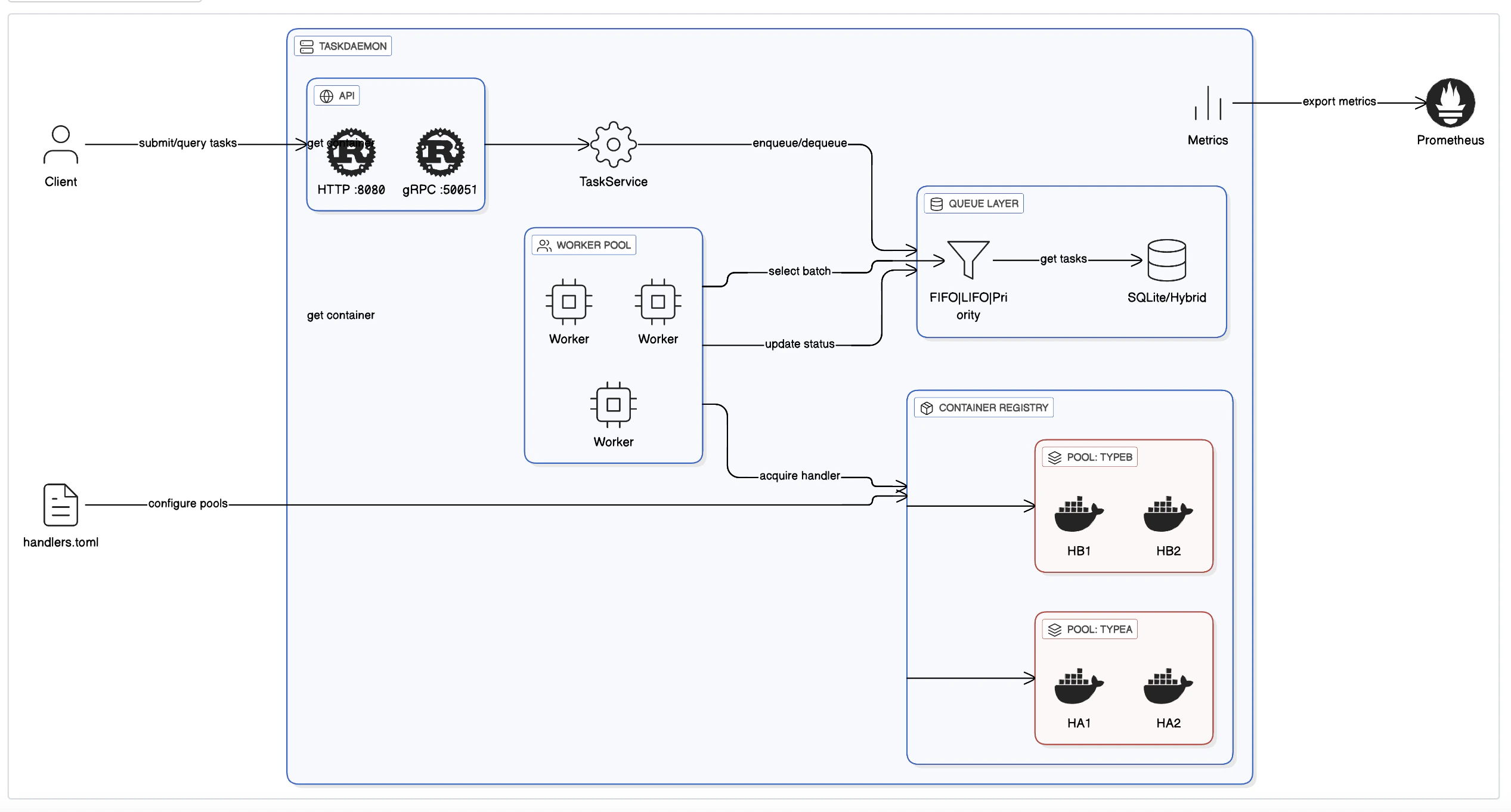
- A client submits a task through HTTP or gRPC.
- The daemon persists it with its priority and retry budget.
- A worker atomically claims a batch and runs its tasks sequentially in the appropriate handler pool.
- The handler reads one JSON request from stdin and returns one JSON response on stdout.
- The daemon persists completion, failure, or a delayed retry.
Quick Example
Python handler:my-greeter:latest, then configure it:
/api/tasks/{task_id} for completed or failed before reading its result.
Handler SDKs
SDK source is maintained in TaskDaemon-Handlers. Package availability and release versions are separate from the daemon image; use a validated SDK release or build from that source. Pythontaskdaemon==0.1.0, Go github.com/jona62/TaskDaemon-Handlers/go@v0.1.2, npm @taskdaemon/handler 0.1.2, crates.io taskdaemon-handler 0.1.2, Maven Central io.github.jona62:handler 0.1.2, and NuGet TaskDaemon.Handler 0.1.2 are published and verified. The guides use these registry releases by default and provide source alternatives where needed.
See the raw protocol to write handlers without an SDK.