> ## Documentation Index
> Fetch the complete documentation index at: https://taskdaemon.mintlify.site/llms.txt
> Use this file to discover all available pages before exploring further.
# Introduction
> High-performance polyglot task processing system built in Rust
# Introduction
TaskDaemon is a high-performance, polyglot task processing system built in Rust. Execute task handlers written in **any language** via containerized workers.
## Why TaskDaemon?
Write handlers in Python, Node.js, Go, Rust, C++, Java, C#, or any language
Each handler runs in its own container with resource limits
Rust core with pre-warmed container pools for sub-10ms latency
Persistent queue, automatic retries, Prometheus metrics
## Key Features
* **Task Selection Strategies** - FIFO, LIFO, or Priority-based task ordering
* **Handler Selection Strategies** - Round-robin, first-available, or random container selection
* **HybridQueue** - In-memory queue with SQLite persistence for speed + durability
* **Priority Tasks** - Queue tasks with priority 0-100 for urgent processing
* **Prometheus Metrics** - Built-in observability with container pool metrics
## How It Works
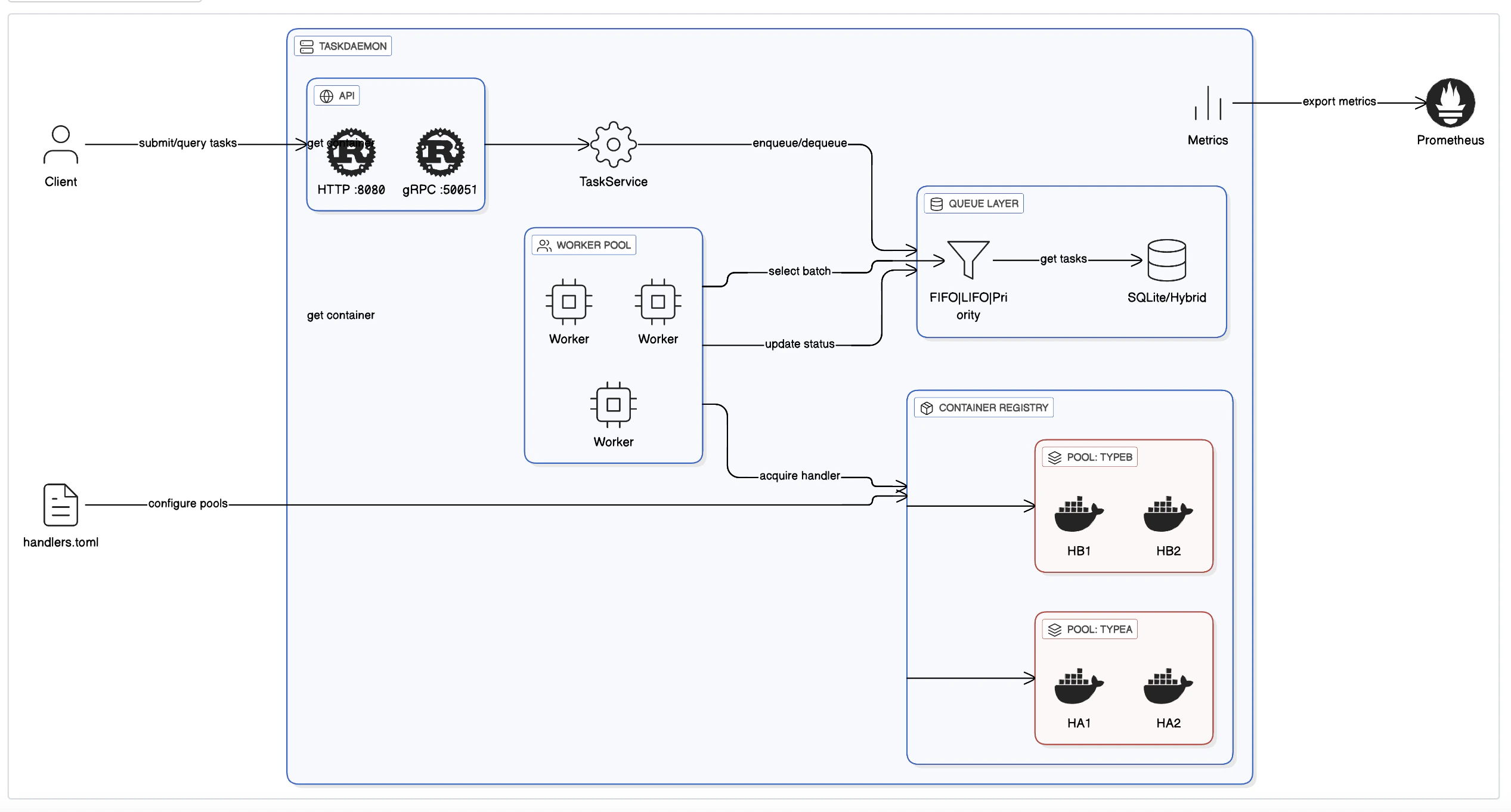 1. Client submits a task via HTTP or gRPC
2. TaskDaemon queues the task (with optional priority)
3. Worker picks up task based on selection strategy
4. Handler container processes task and returns result
5. Result stored and available via API
## Quick Example
```python theme={null}
from taskdaemon import run, Task, Success
def handler(task: Task) -> Success:
name = task.task_data.get("name", "World")
return Success({"message": f"Hello, {name}!"})
run(handler)
```
```toml handlers.toml theme={null}
[handlers.greet]
image = "my-greeter:latest"
instances = 4
handler_selection = "round-robin"
```
```bash theme={null}
curl -X POST http://localhost:8080/queue \
-H "Content-Type: application/json" \
-d '{"type": "greet", "data": {"name": "TaskDaemon"}, "priority": 50}'
```
## Handler SDKs
Official SDKs are available for:
| Language | Package |
| -------- | ----------------------------------------- |
| Python | `pip install taskdaemon` |
| Node.js | `npm install @taskdaemon/handler` |
| Go | `go get github.com/taskdaemon/handler-go` |
| Rust | `cargo add taskdaemon-handler` |
| C++ | Header-only: `taskdaemon.hpp` |
| Java | Maven/Gradle: `com.taskdaemon:handler` |
| C# | `dotnet add package TaskDaemon.Handler` |
Or use the [raw protocol](/handlers/raw-protocol) to write handlers in any language.
## Next Steps
Get running in 5 minutes
Write handlers in your language
Configure handlers and strategies
Complete working example
1. Client submits a task via HTTP or gRPC
2. TaskDaemon queues the task (with optional priority)
3. Worker picks up task based on selection strategy
4. Handler container processes task and returns result
5. Result stored and available via API
## Quick Example
```python theme={null}
from taskdaemon import run, Task, Success
def handler(task: Task) -> Success:
name = task.task_data.get("name", "World")
return Success({"message": f"Hello, {name}!"})
run(handler)
```
```toml handlers.toml theme={null}
[handlers.greet]
image = "my-greeter:latest"
instances = 4
handler_selection = "round-robin"
```
```bash theme={null}
curl -X POST http://localhost:8080/queue \
-H "Content-Type: application/json" \
-d '{"type": "greet", "data": {"name": "TaskDaemon"}, "priority": 50}'
```
## Handler SDKs
Official SDKs are available for:
| Language | Package |
| -------- | ----------------------------------------- |
| Python | `pip install taskdaemon` |
| Node.js | `npm install @taskdaemon/handler` |
| Go | `go get github.com/taskdaemon/handler-go` |
| Rust | `cargo add taskdaemon-handler` |
| C++ | Header-only: `taskdaemon.hpp` |
| Java | Maven/Gradle: `com.taskdaemon:handler` |
| C# | `dotnet add package TaskDaemon.Handler` |
Or use the [raw protocol](/handlers/raw-protocol) to write handlers in any language.
## Next Steps
Get running in 5 minutes
Write handlers in your language
Configure handlers and strategies
Complete working example